Is Minca worth the detour?
Is Minca worth the detour? Yes. Two days works if you're moving through a bucket-list itinerary and just want to hit the highlights. Give it three or more if your trip isn't about checking things off a list — that's what it takes to get past the town center and actually feel the mountain.
Twenty minutes from the center of Minca there is a waterfall called Oído del Mundo, the Ear of the World.
Until recently, getting in was free. You walked down the trail, got in the water, left your trash or you didn't, turned up the music or you didn't. Nobody charged, nobody watched. Free entry and disorder were the same thing.
Now the owners of the farm where that waterfall sits, a place the Indigenous communities consider a sacred site of pagamento, have started charging for access. A coin to enter the Ear of the World. And what sounds like a contradiction, putting a price on something sacred, is actually the first time anyone has answered for the place.
That coin is the whole question.
Because "is Minca worth the detour" sounds like a simple question. You ask it while you're still mapping out your trip to Colombia, or from a bus seat, backpack on your lap, working out whether it's worth breaking your Caribbean itinerary to climb the mountain. And it already has two answers waiting for you.
The guidebooks write the first one. Green Eden, parrots crossing the sunset, toucans, mountain breeze, giant hammocks, coffee. Paradise. The disappointed write the second. One blogger who climbed up, got bitten to pieces, and left furious wrote that Minca is a bug-infested peacock: pretty to look at, but not Colombian, an invasive species escaped from some luxury hotel. He saw two peacocks on a shop roof and decided that was Minca.
He was half right. The peacocks exist, and they really aren't from here. What he didn't see is that he arrived from outside too. So did I.
What's actually true
I'm not going to defend postcard Minca. The Minca of the town center is real, and it's exactly how the complainers describe it.
The streets are dirt and turn to mud. Motorbikes pass within inches. Trucks send diesel straight into your face. The whole town is built for someone staying two days: gluten-free bakery, vegan menu, yoga studio. You hear more English here than almost anywhere else in Colombia. And the jejenes, the biting midges you never feel land, leave your legs marked for weeks, unless you use one of the natural repellents we know well around here.
Cash works the same way. The guidebook swears there are no ATMs in Minca, that you should come up with every peso you plan to spend or you'll get stranded. And that's true and it isn't. There's no bank machine, that part is real. But there are two spots, one at the entrance to town and another near the plaza, where a shop keeps a card reader under the counter: you swipe your card and walk out with cash in hand. What the guidebook sells you as a trap is, here, a two-minute errand someone points you to with a finger.
Anyone who comes up expecting a cobblestone plaza and colonial architecture, the Villa de Leyva or Jardín kind of town, goes back down frustrated. Minca isn't that and never promised to be, whatever the photos suggest.
If you stay in the town center, Minca is a bad joke about ecotourism.
The thing is, the center isn't Minca. It's the waiting room.
The trails the quick guide won't tell you about
I walk several routes. Some easy, some that punish your legs.
There's Cerro Kennedy, six hours climbing through cloud forest up to three thousand meters, where at dawn you see the sea of clouds: the Sierra's peaks poking through like islands over a white ocean, and behind them, if the day is clear, the glaciers of the highest coastal mountain range in the world. There's the silence that begins where the asphalt ends.
I don't work as a guide. But I can recommend one, or give you directions so you get there safely. The trails exist. There are apps, there are markers, there are people who have written the route down. Physically, you can climb without anyone holding your hand.
My doubt was never whether the trails are real. They are. My doubt is what you lose by climbing alone.
A traveler can walk with all the curiosity in the world and still walk right past the story that tree is carrying, the old name of that stream, the fact that turns a pretty view into a place you actually understand. The map doesn't give you that. Someone who lives here and knows how to look does.
And that's where the crack shows. It isn't just about hiking without a guide. It's a bigger one, and it's clearest in the water.
Pozo Azul already charges admission, and on a Sunday it's still chaos: vendors, music stacked on top of music, bottles on the shore. Charging wasn't enough. Putting a price on something doesn't clean a river by itself.
Then there's Las Piedras and La Playita, still free, where the debate stays open. Because the ones who wreck them aren't the foreigners hiking up. It's the crowds that come up from Santa Marta on weekends: four to a motorbike, the sancocho pot, a speaker competing with the one next to it, snack wrappers left behind like decoration. They don't buy anything in town because they brought it all up with them. They take the day and leave the trash.
So you start wondering if it's fair to charge them too. And it's uncomfortable, because charging a fellow Colombian to enter their own river sounds like dispossession. But leaving it free has a cost too, and somebody pays it.
Minca lives that split. The foreigner loves to walk, wants to understand the place, and still trusts the forum thread they read before arriving more than the person standing in front of them. The local from Santa Marta doesn't want to walk, wants the motorbike all the way to the water's edge, the sancocho, the speaker. One takes the experience and distrusts the local. The other takes the outing and leaves the mess. Neither is the villain the other imagines. Both are taking something.
The coin at the Ear of the World isn't the answer. It's only where the question of who answers for the place begins.
So the question changes shape. It's no longer whether the detour is worth it. It's worth it for whom, and who pays the bill.
The laboratory
Minca sits at six hundred and fifty meters, on the mountain's foothills. It wasn't always a destination.
It was coffee land. Before that, it was conflict land. Families who fled the violence more than fifty years ago carved these paths by hand, alongside the peoples who had already been here forever. The coffee they grew went on to become some of the smoothest in the world.
There's a farm, La Victoria, that has been milling since 1892 with machines run on the mountain's own water, without a drop of fossil fuel. A hundred and thirty years tending one process. Long before anyone wrote the word sustainable on a brochure, this place already knew how to inhabit itself differently. The proof that Minca isn't condemned to be what it is today is right here, still running, since the century before last.
But the river tells a different story.
The Minca River was always the community's lifeblood. Today it receives the grease and dirty water from restaurants and hostels that grew without filters. The tourist bathes upstream from the waste their own lunch sends back downstream. The river is the victim and the product at the same time.
And for the peoples who inhabit the Sierra, this isn't a waste management problem. The Sierra is the Heart of the World. A living organism where every single thing holds up the balance of the entire climate. The noise, the trash on the trails, the territory sold off piece by piece: to them, that isn't disorder. It's desecration.
The same road that brought all this up changed the coffee farmer's life. Getting coffee down to Santa Marta used to take six hours, and in the rainy season the harvest was lost. Now it takes an hour and a half. Twenty-six hundred pickers, eight million kilos, a third of all Magdalena's coffee, come down that road. The same paved track the backpacker curses because "there are no trails" is the one that opened up a future for the people who have lived here their whole lives.
Same road. Two griefs that can't be reconciled.
And in the middle of all that, in Minca's schools, there are children learning to defend their river. Five hundred and some students, their teachers, turning the classroom into a place where water, forest, tourism, and peace get argued over. It isn't a gesture. It's the people deciding, slowly, what they want this place to be for.
From the inside
I arrived from outside and I stayed.
I ended up running a place called Río y Fuego. There, together with the team and our allies, we built something that doesn't sell beds, it sells something else: for people to find peace, and sometimes, when our allies' ancestral therapies come in, something deeper than peace.
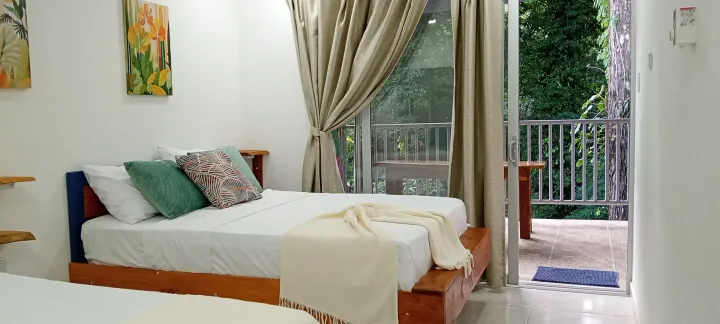
My challenge isn't logistical. It's a matter of conversation. Selling experience instead of a bed, weaving alliances with others, proving that almost everything here comes down to how we communicate and who we choose to team up with. From Río y Fuego I can send you on a tour, to a cacao workshop, to the right restaurant. Lately I've even been supporting the farm that started charging for the Ear of the World, because charging was their way of answering the chaos.
The only thing I truly regret about travelers climbing up alone is what I already said: they miss the stories. But there's a hidden bet in that.
Not every guide knows yet how to create that connection, that moment when you feel that what you received is worth more than a memorized fact. I believe that connection can be taught. If I can prove it exists, I can open workshops, work on it with the community, turn guiding into something people here want to do and know how to charge for.
I've seen it on a small scale. A guest I tell where to eat, what to see, how to get there, comes back down the next day lit up, proud of having pulled it off on just my recommendation. Everything else fits inside that emotion: I tell them what a guide is worth, what it means for the people who live here. Many of them book a tour after that.
Losing that middle role only stings up to a point. Because I understand this doesn't get fixed by excluding anyone. It gets fixed by adding up. I win too when someone who arrived through a different channel ends up, without looking for it, finding what we do.
I like connecting with the people who come from far away. I feel at home there. What I'd want is for more people here to see what I see: that the one who arrives from outside isn't some superior, distant being, they're someone you can build something with. That the value isn't in serving them. It's in looking them in the eye.
So
Let's go back to the coin.
Someone is standing today in front of the Ear of the World, paying to enter a waterfall that was free last year. They can read it as the end of something. They can read it as the beginning of this place learning to answer for itself.
Both readings are true. That's the whole mountain.
If you come up to Minca to check another hidden gem off your list, with two days, in a hurry, without ever leaving the center, you'll probably head back down disappointed and covered in bites. The quick guide warned you.
But if you come up asking what a place wants to live for, and you're willing to let someone from here tell you, the detour stops being measured in kilometers.
The Heart of the World has, up the mountain, an ear.
It's still listening to who climbs, and why.
Want first-hand updates from the Sierra?
Join our letter from the ground. Occasional, without fluff, and unsubscribable at any time.
Join the list